

Whether a wet floor can be saved comes down to three things: what kind of water reached it, how long it stayed wet, and what the floor is made of. The EPA’s cleanup guidance says wet carpet, flooring and the subfloor beneath should be dried within 24 to 48 hours to head off mold (EPA, Mold Remediation Guide, Table 1).
Water damage is one of the most common home insurance losses. Insurance Information Institute figures for 2019 to 2023 show 1.5 water-damage-and-freezing claims per 100 insured homes each year, averaging $15,400 per claim (Insurance Information Institute). North Central Florida also floods from rising water. Hurricane Irma pushed Black Creek to a record 28.5 feet near Middleburg in September 2017 (News4Jax). The National Weather Service gauge on the creek’s North Fork near Middleburg notes that water begins moving into homes at 19 feet (NOAA National Water Prediction Service).
This guide covers what to do in the first two days and how to judge each type of floor. It ends with floors that handle the next leak or flood better.
Key Takeaways
- Dry fast. EPA guidance is to dry wet carpet, flooring and the subfloor beneath within 24 to 48 hours.
- The type of water decides a lot. Carpet pad soaked by gray or black water has to go, and rising floodwater from rivers or streams counts as the most contaminated category.
- “Waterproof” vinyl planks still need to come up if water got underneath, and Mannington’s ADURA Max warranty excludes discoloration from mold or from flooding and plumbing leaks.
- Photograph everything and keep a flooring sample before tear-out. Florida gives homeowners policies a one-year notice deadline, but flood insurance claims need a signed proof of loss, generally within 60 days.
- If you’re rebuilding somewhere that floods, FEMA rates mortar-set ceramic and porcelain tile as acceptable for floodwater contact and rates carpet, laminate and wood floors as unacceptable.
Before Step 1: The first 48 hours
New floors come later. The first two days are about stopping the damage and protecting your claim.
- Make it safe. If the water could be contaminated, EPA guidance calls for protective gear and says fans shouldn’t run until the water is confirmed clean (EPA). Keep children and pets out of the wet area.
- Document before you tear out. The flood insurance program tells policyholders to photograph and video the damage before discarding anything (FloodSmart). It also says to keep samples of carpet and other materials, because the type and quality of the material can change the claim amount. Cut a square of carpet or set aside a plank and bag it.
- Report it. For a homeowners or other property policy, Florida law bars a claim unless the insurer gets notice within one year after the date of loss (Florida Statutes §627.70132). Flood insurance runs on federal rules: FEMA tells NFIP policyholders to submit a signed Proof of Loss form within 60 days after the date of loss (FEMA). Either way, report the loss as soon as you can.
- Start drying. For clean water on carpet, EPA’s steps are a water extraction vacuum, a dehumidifier and fans (EPA). For anything bigger than a spill, call a water mitigation company. They bring commercial drying equipment and moisture meters, and their readings tell you when the subfloor is actually dry. Read their paperwork before you sign. Florida law voids any assignment of post-loss benefits under a residential property policy issued on or after January 1, 2023 (Florida Statutes §627.7152). Ask your insurer how emergency drying gets approved and paid.
A flooring installer belongs at the end of this process, after the subfloor is dry and the adjuster has seen the damage.
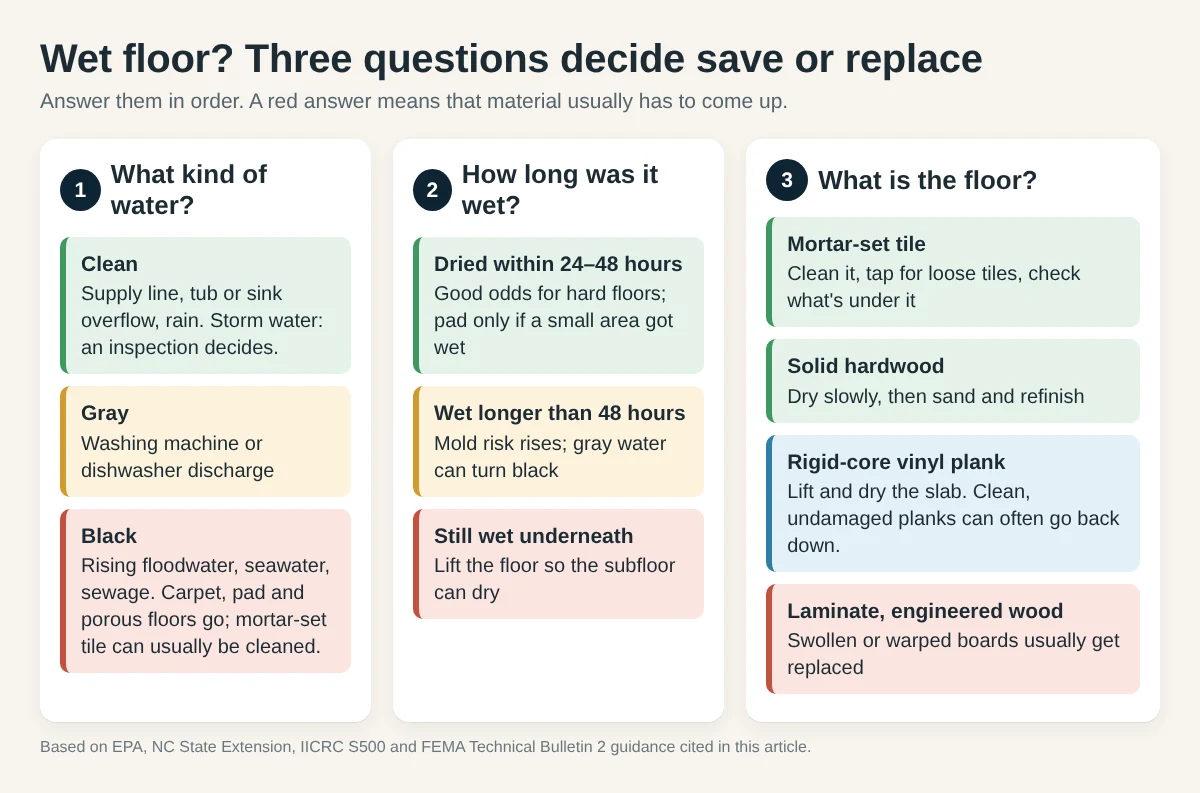 Quick decision guide. Based on the EPA, NC State Extension, IICRC S500 and FEMA Technical Bulletin 2 guidance cited in this article.
The three steps below walk through each question in detail.
Step 1: Figure out what kind of water you’re dealing with
Restoration crews sort water into three categories under the IICRC S500 standard, and the category drives most save-or-replace decisions.
- Clean water (Category 1) includes broken supply lines, tub or sink overflows and rainwater (NC State Extension).
- Gray water (Category 2) is unsanitary water such as discharge from a dishwasher or washing machine. NC State Extension warns that gray water left untreated for more than 48 hours may become black water.
- Black water (Category 3) is grossly contaminated. The S500 definition lists sewage, flooding from seawater and rising water from rivers or streams as examples (IICRC position statement, February 2026).
Hurricane season adds a wrinkle. The S500 definition says Category 3 water can include wind-driven rain from hurricanes and tropical storms. In February 2026, the committee that maintains the standard issued a clarification. Rain coming in from above and water from weather events are “not automatically considered Category 3 Water,” and the restorer’s inspection decides. A roof leak during a tropical storm isn’t the same as Black Creek coming through the front door.
Step 2: Check the clock
EPA’s guidelines are built around drying wet materials within 24 to 48 hours. The agency also notes that mold may grow even when materials dry within 48 hours. It won’t always appear after 48 hours either, since the window is a guideline (EPA).
Humidity stretches that timeline. LSU AgCenter, writing for Gulf Coast homeowners, says drying wood floors may take weeks in a humid climate and less if the space can be dehumidified (LSU AgCenter). The University of Florida’s disaster handbook warns that wood floors dry slowly, over several days or even weeks. It also says not to build fires to rush the job (UF/IFAS Disaster Handbook). Plan on new flooring taking weeks, not days.
Step 3: Decide floor by floor
The table below summarizes the usual outcome for each floor type. The last column is FEMA’s flood damage-resistance rating. FEMA counts a material as flood damage-resistant if it can sit in floodwater for at least 72 hours without damage that needs more than cosmetic repair (FEMA Technical Bulletin 2, 2025). It describes a flood, not a leaking dishwasher.
| Floor type | Clean water, dried within 48 hours | Floodwater, sewage, or wet longer | FEMA floodwater rating |
|---|---|---|---|
| Carpet and pad | Carpet can often be dried; the pad survives only if a small area got wet | Remove carpet and pad | Unacceptable |
| Solid hardwood | Often dries flat; may need sanding and refinishing | Often replaced | Unacceptable |
| Engineered hardwood | Small areas may recover; warped boards get replaced | Replace | Unacceptable |
| Laminate | Swollen boards get replaced | Replace | Unacceptable |
| Rigid-core vinyl plank | Planks survive; lift them to dry the subfloor | Lift, dry the subfloor, replace planks with soaked pads | Not listed |
| Sheet or glue-down vinyl | Check underneath; remove if water is trapped | Remove so the subfloor can dry | Depends on product and adhesive |
| Ceramic or porcelain tile | Clean and check the underflooring | Usually stays if mortar-set on concrete | Acceptable when mortar-set |
Carpet and pad
Carpet pad is the weak link. NC State Extension says pad saturated with gray or black water must be removed and disposed of, with no exceptions (NC State Extension). Pad can be restored only when clean water wet part of a room and the problem was found within 48 hours. Carpet saturated with black water should be removed too. If you dry carpet in place, keep an eye on the corners and closets afterward. Our guide to preventing carpet mold in Florida covers what to watch for.
Solid hardwood
Of the wood floors, solid hardwood is the most likely to come back from a clean-water leak. EPA’s guidance is to remove moisture immediately and dry with dehumidifiers, fans and gentle heat, using caution with heat on hardwood (EPA). After a flood, Oklahoma State University Extension suggests taking out a board every few feet to reduce buckling and calling a professional for tongue-and-groove floors (OSU Extension).
Once the wood is fully dry, the UF/IFAS handbook notes that the surface can be sanded smooth and refinished. Before sanding, have the boards checked with a moisture meter and compared with a dry room in the same house. A cupped floor sanded flat while the boards are still damp can crown once they finish drying. When the floor is truly dry, refinishing it the right way usually costs less than replacing it.
Engineered hardwood and laminate
Both have a core made of layered wood or fiberboard, and FEMA rates both as unacceptable for floodwater contact (FEMA TB 2). Laminate’s fiberboard core swells when it takes on water, and swollen edges usually don’t shrink back. Engineered boards that cup or separate between layers usually can’t be sanded flat the way solid wood can, because the top layer of real wood is thin. After a flood, LSU AgCenter advises removing laminate and other impermeable flooring laid over wood floors as soon as the water recedes (LSU AgCenter).
Rigid-core vinyl plank
Rigid-core planks don’t swell, which is why they’re sold as waterproof. The catch is that they float over the subfloor, so water that gets underneath has nowhere to go. Many have a pad bonded to the back. Mannington, for example, notes that its ADURA MaxAPEX planks already have an attached underlayment pad (Mannington ADURA MaxAPEX Installation Guidelines, 2018 retailer-hosted copy).
Mannington’s ADURA Max limited warranty says it does not cover discoloration from mold or from flooding, leaking plumbing or appliances (Mannington ADURA Max Limited Warranty, 2022 edition, retailer-hosted copy). In practice, pull the planks in the wet area, dry the slab, and inspect each plank. If the water was clean and the locking edges are undamaged, planks can often go back down. An attached pad that soaked up floodwater is in the same position as carpet pad, so plan to replace those planks. Our article on whether waterproof flooring is real explains the difference between a waterproof plank and a waterproof floor.
Sheet vinyl and glue-down vinyl
Glued-down vinyl acts like a lid over the subfloor. LSU AgCenter says to remove vinyl over a wood subfloor if water bubbles appear between the vinyl and the wood, and to expect drying to take several weeks (LSU AgCenter). Texas A&M AgriLife adds that if water has seeped under loose sections of sheet flooring, the entire sheet should come out (Texas A&M AgriLife Extension). Before anyone scrapes old vinyl, see the asbestos note under Step 4.
Ceramic and porcelain tile
Tile usually comes through best. FEMA rates ceramic and porcelain tile set in mortar as acceptable for floodwater contact, but tile set with organic adhesives as unacceptable (FEMA TB 2). EPA’s guidance for tile and other hard flooring is to clean it with water and mild detergent and make sure the underflooring is dry. Tap across the floor afterward. A hollow sound means a tile has lost its bond. If tile sits on a wood subfloor that swelled or separated, Texas A&M AgriLife says the flooring will need to come up (Texas A&M AgriLife Extension).
Step 4: Check what’s under the floor
EPA’s table adds a note to every flooring entry: the subfloor under the carpet or other flooring must also be cleaned and dried (EPA). What that takes depends on the subfloor.
- Plywood can usually stay. NC State Extension says to remove wet carpet and pad and let plywood dry completely before reinstalling anything (NC State Extension).
- Particleboard swells and falls apart when it stays wet for a few days, and NC State Extension says it must be replaced.
- Concrete slabs dry slowly and need a moisture test before new flooring goes down. Mannington’s ADURA Max installation guidelines cap slab relative humidity at 85% using the ASTM F2170 in-situ test (Mannington ADURA Max Installation Guidelines, retailer-hosted copy; current versions on Mannington’s installation page). The same guidelines make the installer responsible for confirming the concrete is dry enough. Ask whoever installs your new floor how they’ll test.
Older homes need one more check. Vinyl floor tiles, the backing on sheet vinyl and the adhesives under them may contain asbestos (Georgia Department of Public Health). Oklahoma State’s flood guidance tells families with asbestos flooring to get professional guidance (OSU Extension), and Texas A&M AgriLife says asbestos tiles should be removed only by a trained professional. Don’t sand or scrape a suspect floor to find out.
Step 5: Sort out insurance, warranty and permits before you rebuild
Leak or flood? Insurers treat them differently. FloodSmart, the federal flood insurance site, says most homeowners and renters insurance does not cover flood damage (FloodSmart). Flood insurance covers losses directly caused by flooding, and its building coverage includes permanently installed carpeting (FloodSmart). A burst supply line, on the other hand, is often a homeowners claim. Check your own policy for the details.
Warranty. Read the flooring warranty before you file. Some floor warranties exclude exactly the water events insurance is meant to cover. Mannington’s ADURA Max warranty, for example, excludes discoloration from flooding and from plumbing or appliance leaks.
Permits and the 50% rule. Homes in a FEMA Special Flood Hazard Area have an extra step. A local building official or floodplain manager decides whether the home is “substantially damaged” (FEMA fact sheet). That means the cost of repairs is 50% or more of the structure’s market value before the disaster. A substantially damaged home has to be brought into compliance with local floodplain regulations. FEMA also advises checking with local building officials about which permits are required before work begins. Replacing floors alone may not reach that threshold, but floors plus drywall, cabinets and appliances can. Call your county building department before the tear-out turns into a rebuild.
Rebuilding: Floors that handle the next one better
If your home has flooded once, assume it can flood again, and choose materials accordingly. FEMA’s 2025 Technical Bulletin 2 rates these floor finishes as acceptable for prolonged floodwater contact (FEMA TB 2):
- Ceramic and porcelain tile set in mortar
- Concrete tile set in mortar, and terrazzo
- Formed-in-place epoxy and polyurethane floors
- Homogeneous vinyl sheets or tiles installed with chemical-set adhesives
The same table rates carpeting, linoleum, tile set with organic adhesives, and wood floor coverings (including engineered wood and plastic laminate) as unacceptable.
Rigid-core vinyl plank isn’t in FEMA’s table. For unlisted materials, the bulletin says the manufacturer’s literature should be reviewed, and the local official decides whether to accept them as flood damage-resistant.
For leaks inside the house, rigid-core plank is a practical choice. The planks shrug off water, and a floating floor can be lifted to dry the slab without demolition. Our vinyl plank and waterproof flooring pages show current lines, and this lake house vinyl plank project shows a floating floor in a waterfront home.
For homes that take on rising water, such as those along Black Creek or the St. Johns River, porcelain tile set in mortar is the safer long-term floor. Our guide to the best flooring for Florida’s climate compares the everyday options.
Once the subfloor is dry and your adjuster has seen the damage, we can measure the space and help you choose a floor suited to the room and its flood risk. Our showroom is at 1365 South Water Street in Starke, and we serve Middleburg, Green Cove Springs, Palatka, Gainesville, Starke and the rest of North Central Florida.
Frequently Asked Questions
Can water-damaged hardwood floors be saved?
Often, if the water was clean and the floor was dried quickly. Solid hardwood can cup and then flatten as it dries, and once moisture readings are back to normal it can be sanded and refinished. Hardwood soaked by floodwater is usually replaced, and FEMA rates wood floor coverings as unacceptable for floodwater contact (FEMA TB 2).
Do I have to replace vinyl plank flooring after a flood?
Not always. Rigid-core planks don’t swell, but they have to come up so the subfloor can dry. Clean planks with undamaged locking edges can often be reinstalled. Planks whose attached pad soaked up floodwater should be replaced, and manufacturer warranties may not cover flood damage.
How long does a concrete slab need to dry before new flooring goes down?
There’s no fixed number of days. The slab is ready when it passes the flooring manufacturer’s moisture test. Mannington’s ADURA Max guidelines, for example, cap relative humidity at 85% using the ASTM F2170 test (Mannington ADURA Max Installation Guidelines, retailer-hosted copy). In Florida’s humidity, expect weeks rather than days.
Does homeowners insurance pay for new floors after a water leak?
A sudden leak such as a burst supply line is often covered by a homeowners policy, but most homeowners policies do not cover flooding, which needs a separate flood policy. Photograph the damage and keep a flooring sample before tear-out. Florida law gives a homeowners claim a one-year notice deadline (§627.70132), while an NFIP flood claim needs a signed proof of loss within 60 days (FEMA).
Should I pull up wet carpet myself?
For a small clean-water spill caught early, you can extract the water, lift the carpet and dry it. Pad soaked by gray or black water has to be thrown out (NC State Extension). For floodwater or sewage, wear protective gear or hire a water mitigation company, and keep a carpet sample for your adjuster.
About this guide
How this guide was put together: The recommendations come from public guidance by FEMA, the EPA, the IICRC, university extension services and the Florida Statutes. Manufacturer installation and warranty documents fill in product details, and each one is linked where it is cited. Some points reflect standard flooring installation practice rather than a cited source. These include tapping tile to find loose pieces, waiting to sand cupped wood, lifting floating floors to dry a slab, and the general notes on refinishing costs and insurance coverage. Insurance terms and permit rules vary by policy and county, so confirm those questions with your insurance agent and your county building department. This guide is general information, not legal or insurance advice.